Katholische Kindertagesstätte Sankt Pankratius Evinghover Weg

Wir betreuen Kinder im Alter von einem (Stichtag 31.07. des entsprechenden Jahres) bis zu sechs Jahren

Address
Katholische Kindertagesstätte Sankt Pankratius Evinghover Weg
Evinghover Weg 4
50769 Köln
Funding authority
Katholino Kindertagesstätten im Erzbistum Köln gGmbH
Salierring 47
50677 Köln
Kita.st.pankratius.50769@katholino.de
http://www.katholino.de
0221 / 782882 (Barbara Fischer)
Opening times7:00 AM - 4:00 PM o'clock
Closing daysLetzten drei Wochen in den Sommerferien
Zwischen Weihnachten und Neujahr
Rosenmontag und Veilchendienstag
Ein Konzeptions- und ein Bildungstag

• Zwischen Weihnachten und Neujahr
• Rosenmontag und Veilchendienstag
• Ein Konzeptions- und ein Bildungstag
Denomination roman catholic
Specially educational concept Situation approach
Extras Barrier-free, care with lunch, family counseling, full day care

Current information

Introduction/specifics

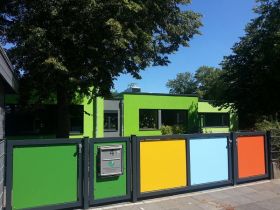
At our Catholic institution Sankt Pankratius, 51 children aged between one and six are cared for in three groups, I, II, and III, in accordance with the Child Education Act (KiBiz). Since the last renovation in 2011, the groups have been named after the colors blue, yellow, and orange, which are reflected in the design of the rooms.

Rooms

When you enter our facility, you arrive in a large, bright entrance area. Here, there is a cozy seating area for parents, where they can enjoy a cup of coffee. From time to time, we also hold group meetings or celebrate parties together here.

The hallway leads to the respective groups and the associated child-friendly washrooms. Each group has its own children's kitchen, and the group room is divided into different play areas. In addition, each group room has a separate sleeping area and an adjoining room.

Adjacent to the blue group is an additional changing room. A second changing room for the yellow and orange groups can be reached via the hallway. A functionally equipped gym can be used individually by all groups.

In our kitchen, our “kitchen fairy” distributes drinks for breakfast and lunch delivered by a catering company, as well as washing the used dishes. The office provides an opportunity to exchange information, register children, or hold parent-teacher conferences. Our staff room is used for biweekly team meetings, parent-teacher conferences, and the monthly counseling session held by the family counseling center.

We strive to create an environment in our rooms that offers a cozy atmosphere for children, parents, and staff.

Outdoor Facilities

Our spacious outdoor area features various trees and shrubs, swings, a climbing frame, log mikado, a tree house, and a water pump with mud tables, offering children plenty of opportunities to climb, explore, try things out, romp around, play hide and seek, and play in the mud. A paved area invites children to use various vehicles. A separate garden area with a sandpit, climbing frame, and a small lawn offers children under the age of two the opportunity to crawl, run, play, and climb safely.

Daily Schedule

  • 7:00/7:30 a.m.: The day begins!
  • 7:00 to 9:00 a.m.: All children should arrive at the facility during this time.
  • 7:30 to 11:00 a.m.: Free play takes place during this time. The children can choose for themselves what they want to play and with whom. They can choose from a wide variety of materials, such as board games, puzzles, picture books, building and construction materials, a doll's corner with the opportunity to dress up, creative areas, and much more.
  • At the same time, the teachers offer guided activities in small groups, provide inspiration, or accompany the children as they play.
  • During free play, the children also have the opportunity to eat breakfast, and birthday parties, discussion groups, and morning and chair circles take place, where they sing, play, and make music.
  • 11 a.m. to 12 p.m.: During this time, we go outside with the children in all weather conditions. Once a week, each group has its gym day.
  • We end the morning together as a group with a final game or song.
  • 12:00 p.m.: All groups have lunch. Afterwards, children who wish to do so have the opportunity to take a nap in the quiet room. All other children calm down with quiet activities in the group.
  • 2:00 p.m. to 3:45 p.m.: Various activities will also be offered and carried out for and with the children in the afternoon. The children will also meet again to enjoy a small snack. Parents who wish to pick up their children are welcome to do so during this time.

Food

At around 12 noon, all the children eat lunch together in their groups.

The food is prepared and delivered daily by a catering company using fresh produce. It is important to us to eat with the children in a family-like setting at a nicely set table in a calm atmosphere. This gives the children the opportunity to practice using cutlery correctly. In order to teach the children to appreciate food, they are first allowed to try the food on offer and then decide for themselves whether they would like more.

Care providers are responsible for all profile content. (State: 30/01/2026 11:56:18)

Description and Stations

Unsere Kindertagesstätte St. Pankratius liegt etwas abseits vom alten Ortskern Worringen entfernt. Trotz seiner unterschiedlichen Wohngebiete (Ein- und Mehrfamilienhäuser) hat sich Worringen mit seinen ca. 10.000 Einwohnern einen dörflichen Charakter bewahrt.

Schule, Ärzte und Geschäfte für den täglichen Bedarf sind ausreichend vorhanden und gut zu erreichen.

Es gibt aus Richtung Köln, als auch aus Richtung Neuss/ Düsseldorf kommend die günstige Verkehrsanbindungen der BAB 57 oder die öffentlichen Verkehrsmittel der Linie S11 mit Zielbahnhof Köln-Worringen. Von dort bringt Sie die Buslinie 120 (Richtung Blumenberg) nach zwei Haltestellen und wenigen Schritten, bis zu unserer Kita.

Care providers are responsible for all profile content. (State: 30/01/2026 11:56:18)

Basics

Our facility is a special living space for children. We encourage play and thus support children's joy of discovery and experimentation. By visiting our facility daily and regularly, your child learns to interact with other people. Where possible, this can also take place together for children with and without disabilities. Every child should feel accepted with their individual stage of development, their thinking, and their abilities. By living and playing together with others and participating in joint activities, your child will gain confidence, experience joy, and learn to deal with disappointment. Your child will discover and develop their own potential. This happens in a targeted manner in daily interactions and is based on both the needs of the children and seasonal Christian festivals and customs. A structured daily routine with fixed rituals, such as daily prayer before lunch, gives the children a sense of security.Each group develops individual framework plans that are tailored to the living situations of the children in the individual groups. Current experiences and events are taken up and discussed with the children. Under certain circumstances, this can result in a play activity, a change in the daily routine, or a new group rule. In any case, the children should be motivated to participate in shaping the program and, where possible, to take on responsibility. In order to provide the children with a permanent caregiver to whom they can turn to with confidence, we have deliberately opted for a system of fixed groups in our facility. This approach enables us to observe and track the developmental stage of each individual child, discuss it within the team, and thus gain a holistic picture of each individual child. For parents, this also means that they can talk to designated contact persons about their child's development and seek advice at any time. Although the groups are fixed, there are many opportunities for cross-age encounters and play in everyday group life. Especially during free play on theOutdoor areas regularly give rise to play groups spanning different age groups. Additional joint activities for younger and older children, including those across different groups, help to develop an understanding of different needs. The daily routine regularly provides opportunities for both age-appropriate and cross-age encounters and activities. The most important goal in our work is to provide your child with a trusting environment in which they can feel comfortable and secure. Guided by our Christian faith and values, we see it as our task to give your child enough space and time to develop their personality, while offering them our guidance and support.

Employee

Our facility currently employs six teachers, two childcare workers, one early childhood educator, one daily care assistant, one social worker, and one daycare center manager. We also have one PIA trainee (childcare).

Qualification

In order to provide competent support to children in their development and parents in their educational responsibilities, the personality, qualifications, and professionalism of the staff at the facility are of paramount importance. To ensure this, our employees, who are all qualified specialists, continuously participate in training events organized by the Diocesan Caritas Association.

Regular case discussions and fortnightly team meetings ensure the high quality of our work.

Because the training of qualified professionals is very important to us, we are happy to offer interested students internships at our facility. In addition, we work closely with the technical colleges for social pedagogy responsible for training educators and childcare workers. We also enable college and university students to complete their practical semester with us.

Additional Offerings


Since 2007, our daycare center has been certified as both a Catholic and a Family Center NRW.As part of this, we offer monthly consultation hours with a family counseling center on the daycare center premises.In addition, we offer many different services (e.g., parent-child groups, first aid courses, a meeting place for everyone, children's church, and much more) for families.

Quality Assurance

Daycare centers play an important role in education and training. This role stems from the unique circumstances of daycare children. Daycare centers are the first stage of our education system. Learning in a daycare center traditionally differs from learning in school: it must be holistic and playful. However, children also gain important learning experiences through the targeted activities offered by the teachers.

The different developmental processes of the children are observed by the staff at our facility and, with the written consent of the parents, documented with the help of a qualified educational program. Special attention is paid to language development, which is integrated into everyday life with the help of an everyday language program (BaSik). The documentation of the child's educational processes serves as supplementary written information for parents and is the subject of development discussions (birthday discussions).During development meetings, which are held with parents around the time of their child's birthday, parents are actively informed about their child's educational progress. Parents have the right to view their child's educational documentation at any time and to request that it be released to them. When their child's care at our facility ends, parents are given the educational documentation.At parent-teacher conferences and through regular letters to parents, parents are informed about everyday life at the daycare center, dates, and any new developments.

Cooperations

  • Catholic Education Center
  • Catholic Family Counseling Center
  • Child Day Care Contact Center
  • Speech Therapy
  • Elementary Schools
  • Day Care Centers
  • Day Care Providers
  • Senior Citizens' Groups, etc.

Teamwork with school

Several times a year, the school and daycare center administrators of the local schools and daycare centers meet to exchange information, consult with each other, and jointly plan various projects. In addition, the respective teachers visit us shortly before the children start school, or we visit the school with the future newcomers.

Teamwork with parents

Parents are experts when it comes to their children. Together with them, we want to accompany and support their child in their development. For this to succeed, trusting and open communication between parents and educators is very important and a basic prerequisite for our educational activities. Informal chats are extremely important in this regard and give us the opportunity to gain an insight into the different family situations. During the so-called birthday meetings, we take sufficient time for an in-depth discussion about the child's stage of development. This also provides an opportunity to discuss personal concerns in detail.

In order to make everyday life transparent for parents, the facility offers a variety of services:

  • Daycare app
  • Information boards in the entrance area and in the group areas or on doors
  • Portfolio
  • Parent evenings
  • Parent letters
  • Visits by appointment

One way to get actively involved is to join the parents' council, which is elected by the parents. The parents' council represents the interests of the parents vis-à-vis the educational staff working at the facility and the operator. They are informed by the operator and/or management about everything essential concerning the daycare center. Of course, we are also happy when the parents' council supports us in planning and organizing parties and activities.

In addition, you have the opportunity to join our support association, “Katholischer Kindergarten St. Pankratius” (St. Pankratius Catholic Kindergarten). The support association assists the facility with new purchases, excursions, and celebrations, or organizes these independently.


Specifics

Pädagogischer Ansatz

Kinder haben von Anfang an eigene Rechte und vollziehen die für ihre Entwicklung und Entfaltung notwendigen Schritte durch eigene Aktivität.

Wir als Erwachsene haben die Aufgabe und Verantwortung, die Kinder in ihrer Entwicklung und dem damit verbundenen Handeln zu begleiten, zu unterstützen und zu fördern.

Dies geschieht gezielt im täglichen Miteinander und richtet sich sowohl  nach den Bedürfnissen der Kinder, als auch an jahreszeitlichen christlichen Festen und Gebräuchen. Ein strukturierter Tagesablauf mit festen Ritualen gibt den Kindern Sicherheit.   

Aktuelle Erlebnisse und Ereignisse der Kinder und Familien werden aufgegriffen und gemeinsam besprochen. Unter Umständen kann daraus eine Spielaktion, eine Veränderung im Tagesablauf oder eine neue Gruppenregel entstehen.

In jedem Fall sollen die Kinder motiviert werden mitzugestalten, und wo es möglich ist, Verantwortung zu übernehmen.                                                                                                        

Um den Kindern eine feste Bezugsperson zu bieten, an die sich das Kind immer wieder vertrauensvoll wenden kann, haben wir uns in unserer Einrichtung bewusst für das System der festen Gruppen entschlossen.

Auch für die Eltern bedeutet das, dass sie sich jederzeit mit festen Ansprechpartnern über die Entwicklung ihres Kindes unterhalten und beraten können.

Obgleich die Gruppen eine feste Zuordnung haben, ergeben sich im Gruppenalltag viele Gelegenheiten für altersübergreifende Begegnung und Spiel. Gerade im Freispiel auf dem Außengelände entstehen regelmäßig altersübergreifende Spielgemeinschaften. Regelmäßig ergeben sich aus der Gestaltung des Tagesablaufes sowohl altersentsprechende als auch altersübergreifende Begegnungen und Aktivitäten.

Religionspädagogischer Ansatz

Über den gesetzlichen Bildungs- und Erziehungsauftrag hinaus wollen wir den Kindern unseren christlichen Glauben näher bringen. Wir glauben, dass Gott die Welt erschaffen hat, in Jesus Christus Mensch geworden ist und in seiner Kirche lebt und wirkt. Durch kindgerechte Geschichten, Bilder und Lieder vermitteln wir den Kindern die Inhalte unseres Glaubens. Wir erzählen, sprechen und beten mit den Kindern zu Gott und vermitteln im täglichen Miteinander die christlichen Grundwerte wie Achtung voreinander haben, Trösten und Verzeihen, Helfen, sowie Bitten und Danken.

Eingewöhnung

Für die meisten Kinder unter drei Jahren bedeutet der Kindergartenbesuch auch gleichzeitig die erste Trennung von den häuslichen Bezugspersonen. Daher ist die Eingewöhnungsphase für diese Kinder besonders wichtig. Wenn Eltern es wünschen, bieten wir an, dass die neuen Bezugspersonen (Erzieherinnen) des Kindes, die Familie vor der Aufnahme zuhause besuchen. Darin soll die Wertschätzung für die Familie und die Offenheit für einen partnerschaftlichen Dialog spürbar werden. Die Begegnung zu Hause, ist für Eltern und Kinder, häufig offener und freier als im institutionellen Umfeld der Kita. Außerdem: Für das Kind wie für die neue Bezugsperson ist es ein Vorteil, wenn sie beim ersten Treffen in der Kindertagesstätte auf vertraute Gesichter stoßen und - insbesondere für das Kind- nicht alles völlig neu ist.

Dieses Gespräch dient einerseits, um noch offene Fragen zu klären, andererseits soll es Aufschluss geben über die Persönlichkeit eines Kindes. Dazu gehören zum Beispiel feste Gewohnheiten und Rituale von zu Hause, spezielle Vorlieben, der Tagesrhythmus sowie Essens-und Schlafgewohnheiten. Für die neuen Bezugspersonen ist es ebenso wichtig zu erfahren, ob das Kind unter chronischen Krankheiten oder Allergien leidet, als auch zu wissen, wie die bisherige Entwicklung verlief. Ein hilfreiches Instrument ist uns hierbei unser Eingewöhnungsbogen, welchen die Eltern beim Aufnahmegespräch ausgehändigt bekommen haben.

Die Eingewöhnung in unserer Einrichtung gestaltet sich in Anlehnung an das Berliner Eingewöhnungsmodell. Damit sich jedes Kind in seinem eigenen Tempo an die Erzieherin und seine neue Umgebung gewöhnen kann, erfolgt die Eingewöhnung unter Einbeziehung der Erziehungsberechtigten, ganz individuell und im sorgfältigen Dialog zwischen Eltern und Erzieherinnen.

Bildungsdokumentation

Innerhalb der Erziehungs-und Bildungsarbeit nimmt der Kindergarten eine wichtige Rolle ein. Sie ergibt sich aus der Besonderheit der Lebenssituation von Kindergartenkindern. Der Kindergarten ist die erste Stufe unseres Bildungssystems. Lernen im Kindergarten unterscheidet sich traditionell von schulischen Lernformen: Es muss ganzheitlich und spielerisch sein.

Die unterschiedlichen Entwicklungsprozesse der Kinder werden von den Mitarbeiterinnen unserer Einrichtung beobachtet, und nach schriftlicher Zustimmung der Eltern,  dokumentiert. Die Dokumentation der Bildungsprozesse des Kindes dient der ergänzenden schriftlichen Information der Eltern und ist Gegenstand von Entwicklungsgesprächen (Geburtstagsgespräch). Die Eltern haben das Recht, Einblick in die Bildungsdokumentation Ihres Kindes zu nehmen und ihre Herausgabe zu fordern. Die Bildungsdokumentation wird nicht an dritte weitergegeben und wird mit Ende der Betreuung des Kindes in unserer Einrichtung, den Eltern ausgehändigt. In den  sogenannten „Geburtstagsgesprächen“, welche jeweils in der Zeit um den Geburtstag des Kindes mit den Eltern geführt wird, werden die Eltern aktiv über den Bildungsverlauf ihres Kindes informiert. Bei Elternabenden und regelmäßig ausgegebenen Elternbriefen, werden die Eltern über den Alltag in der Kindertagesstätte und alle Neuerungen informiert.

Gesetzliche/Kirchliche Bestimmungen

In unserer Arbeit richten wir uns nach dem nordrhein-westfälischen Gesetz zur frühen Bildung und Förderung von Kindern (Kinderbildungsgesetz-KIBIZ) und dem Statut für die katholischen Kindertageseinrichtungen in den Erzbistümern Aachen, Essen, Köln, Münster und Paderborn. Dieses Statut wird bei der Aufnahme des Kindes mit der Broschüre „Für Ihr Kind- die katholische Kindertageseinrichtung“ an die Eltern ausgehändigt.

Finanzierung der Einrichtung

Das Kinderbildungsgesetz sieht vor, dass alle Personal- und Sachkosten einer Kindertagesstätte-unabhängig von der tatsächlichen Kostenhöhe-pauschal mittels so genannter Kindpauschalen gefördert werden. Die Höhe der gewährten Kindpauschalen ist abhängig von der Anzahl der aufgenommenen Kinder, ihrer wöchentlichen Betreuungszeit und den angebotenen Betreuungsformen.

Kommune und Land tragen die Kindpauschalen, abzüglich des Eigenanteils des Trägers. Dieser Eigenanteil, in Höhe von 12%, wird vornehmlich aus Kirchensteuermitteln finanziert.  Die Stadt Köln legt für ihren Bereich fest, ob, und in welcher Höhe die Eltern zu Beiträgen gegenüber dem Jugendamt verpflichtet werden. Die Höhe der derzeit geltenden Elternbeiträge finden Sie unter: http://www.stadt-koeln.de/service/produkt/elternbeitraege-der-kindertageseinrichtungen

Gesundheitsvorsorge/ Versicherungsschutz

Bei der Aufnahme des Kindes, muss dem Kindergarten eine ärztliche Bescheinigung, sowie eine Kopie des U-Heftes vorgelegt werden. Ebenfalls erwarten wir nach Verdacht, und allen durchgemachten, ansteckenden Krankheiten oder Kopflausbefall, eine Bescheinigung des Kinderarztes, dass das Kind frei von ansteckenden Krankheiten/ Läusen ist. Grundsätzlich ist es uns untersagt, den uns anvertrauten Kindern, Medikamente zu verabreichen. Sollte eine medikamentöse Therapie bei Ihrem Kind erforderlich sein, müssen Sie als Eltern die Grundmedikation selber durchführen. Ausnahmen hiervon sind in Einzelfällen nur bei chronisch kranken Kindern möglich, deren Aufnahme zusätzliche, über den Betreuungsvertrag hinausgehende Vereinbarungen erforderlich macht.

Das Gesundheitsamt der Stadt Köln führt jährlich in unserer Einrichtung eine zahnärztliche Untersuchung durch. Über die Termine werden die Eltern frühzeitig, durch einen Aushang in der Kindertagesstätte, informiert.

Beim regelmäßigen Besuch der Kindertagesstätte, für die Wege zur und von der Einrichtung sowie bei besonderen Veranstaltungen besteht für Ihr Kind ein gesetzlicher Unfallversicherungsschutz. Versichert sind Unfälle, die Ihr Kind in ursächlichem, örtlichem und zeitlichem Zusammenhang mit der Kindertagesstätte erleidet. Hinsichtlich des Hin-und Rückweges ist darauf zu hinzuweisen, dass nur für den unmittelbaren Weg Versicherungsschutz besteht.

Care providers are responsible for all profile content. (State: 30/01/2026 11:56:18)

Parental Interviews

Take place regularly as part of the work of the family center.

Care providers are responsible for all profile content. (State: 30/01/2026 11:56:18)

Overview

After consulting with the teaching staff and the parents' council, the institution's sponsor determines the admission criteria for a kindergarten year according to a points system and reviews these criteria annually.

The following criteria are taken into account:

  • Single parent
  • Religion of the child to be admitted
  • Religion of the parents
  • Parish affiliation of the family
  • Siblings who already attend or have attended our facility

Care providers are responsible for all profile content. (State: 30/01/2026 11:56:18)

Maps are displayed only if you accept the corresponding cookies.
enable map

A Service of  LITTLE BIRD GmbH

cookie settings

We use cookies on our website. Some of them are essential for use, while others help us improve the service on this site. You can find more information about this in our privacy policy.